
Clear records
history record

News
How to Size an Incinerator for a Factory or Hospital


Selecting the correct incinerator capacity is a practical engineering decision that directly affects operating safety, compliance, cost control, and long-term reliability. For factories and hospitals, incinerator sizing is not simply a matter of choosing the largest unit available. An undersized system will overload quickly, while an oversized system leads to poor combustion efficiency and unnecessary capital and operating burdens. This article provides a grounded, step-by-step explanation of incinerator sizing, focusing on real operating data and application-specific requirements rather than abstract theory.
Why Proper Incinerator Sizing Matters
Incinerators operate within a defined thermal and material balance. When waste input exceeds design limits, incomplete combustion, excessive emissions, refractory damage, and frequent downtime become inevitable. Conversely, when the unit is consistently operated far below its rated capacity, fuel efficiency drops, combustion stability suffers, and auxiliary burners must work harder to maintain temperature.
For factories and hospitals—where waste generation is continuous and often regulated—correct incinerator sizing ensures:
Stable combustion and temperature control
Compliance with environmental regulations
Predictable operating costs
Longer equipment service life
Adequate flexibility for future waste volume changes
In short, incinerator sizing is a foundation decision that influences every downstream aspect of the waste treatment system.
Step 1: Identify Waste Type and Characteristics
The first and most critical step in incinerator sizing is understanding the waste itself. Different waste streams behave very differently in a combustion chamber.
Typical Waste Streams
Hospitals: infectious waste, pathological waste, sharps, pharmaceutical residues, limited chemical waste
Factories: production residues, sludge, packaging waste, contaminated solids, off-spec products
Key Waste Parameters
When evaluating waste, the following parameters should be measured or reasonably estimated:
Average and peak daily waste quantity (kg/day)
Bulk density (kg/m³)
Lower heating value (LHV, kcal/kg or MJ/kg)
Moisture content (%)
Ash content (%)
For example, hospital medical waste often has a higher calorific value due to plastics and packaging but may include high-moisture components such as tissues. Industrial sludge, on the other hand, may have very low heating value and require auxiliary fuel support.
Accurate waste data is the cornerstone of effective incinerator sizing.
Step 2: Define Throughput Requirements
Incinerator sizing is normally based on hourly throughput, not just daily volume. This is where many projects encounter issues.
Continuous vs. Batch Operation
Continuous operation: common in medium to large factories, requires stable hourly feed
Batch operation: common in small hospitals or clinics, allows flexible loading schedules
To calculate required capacity:
Determine total daily waste (e.g., 2,400 kg/day)
Define realistic operating hours (e.g., 16 hours/day)
Calculate average hourly load:
2,400 ÷ 16 = 150 kg/hour
A safety margin (typically 10–30%) is then added to account for peak loads and operational variability. In this case, a nominal capacity of 180–200 kg/hour would be reasonable.
This practical approach ensures the incinerator is neither stressed nor underutilized.
Step 3: Consider Regulatory and Temperature Requirements
Regulatory requirements directly influence incinerator sizing, particularly combustion chamber volume and residence time.
Typical Compliance Factors
Primary chamber temperature: often 800–900°C for medical waste
Secondary chamber temperature: typically ≥850°C, with ≥2 seconds gas residence time
Complete burnout of solids
Higher residence time requirements mean larger combustion chambers or lower feed rates. This directly affects incinerator sizing and cannot be ignored during selection.
Hospitals, in particular, must comply with strict emission and pathogen destruction standards, making conservative sizing a safer choice.
Step 4: Match Incinerator Type to Application
Different incinerator designs handle waste differently. Choosing the correct type is inseparable from sizing decisions.
Common Incinerator Types
Static hearth incinerators
Rotary kiln incinerators
Controlled-air (starved air) incinerators
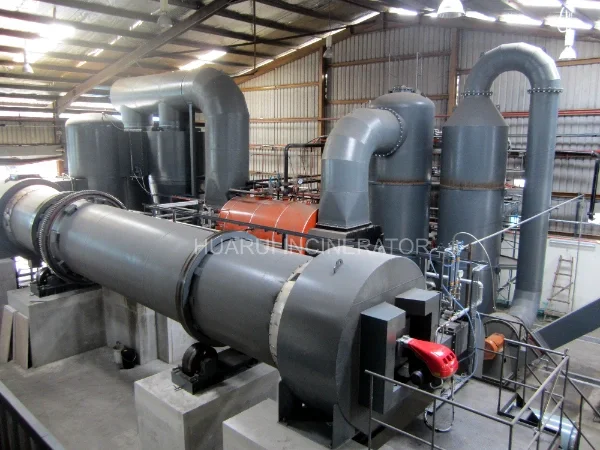
For mixed or difficult waste streams—such as pharmaceutical waste, sludge, or variable industrial residues—a rotary kiln incinerator is often preferred due to its excellent mixing and burnout performance.
A properly sized rotary kiln incinerator allows for stable handling of waste with varying calorific values and moisture content, making it particularly suitable for factories with fluctuating waste composition and hospitals dealing with multiple waste categories.
Step 5: Account for Auxiliary Systems
Incinerator sizing does not stop at the combustion chamber. Supporting systems must be sized consistently with the main unit.
Systems That Scale with Incinerator Size
Feeding system (ram feeder, screw feeder, or manual loading)
Secondary combustion chamber
Flue gas treatment system (quench, scrubber, baghouse, stack)
Ash handling and storage
For example, increasing incinerator throughput by 30% without resizing the flue gas system can result in excessive pressure drop or emission non-compliance.
A well-designed incinerator system is balanced across all components.
Step 6: Plan for Operational Flexibility
Waste volumes rarely remain constant over the life of an incinerator. Expansion of hospital services or factory production lines can quickly push a system beyond its original limits.
Best practices include:
Selecting a unit with moderate spare capacity
Designing feeding systems that can accommodate higher loads
Reserving space for future emission control upgrades
However, flexibility should not be confused with oversizing. A carefully calculated margin is preferable to a system that never reaches optimal operating conditions.
Step 7: Practical Sizing Examples
Hospital Example
Daily waste: 1,200 kg/day
Operating hours: 12 hours/day
Required capacity: 100 kg/hour
Recommended size with margin: 120–150 kg/hour
Factory Example
Daily waste: 6,000 kg/day
Operating hours: 20 hours/day
Required capacity: 300 kg/hour
Recommended size with margin: 350–400 kg/hour
In both cases, actual waste testing and engineering review should confirm assumptions before final selection.
Common Mistakes in Incinerator Sizing
Relying on peak waste figures without considering operating hours
Ignoring moisture content and heating value
Oversizing to “be safe,” resulting in poor efficiency
Neglecting future regulatory tightening
Avoiding these mistakes requires collaboration between the waste generator, equipment supplier, and environmental engineer.
Conclusion
Incinerator sizing is a technical and operational decision that must be based on real waste data, realistic operating conditions, and regulatory requirements. For factories and hospitals, the goal is not maximum capacity, but stable, compliant, and efficient operation over the full life cycle of the system.
By carefully analyzing waste characteristics, defining throughput needs, selecting the appropriate incinerator type, and allowing for reasonable flexibility, organizations can implement an incineration system that delivers reliable performance without unnecessary cost or risk.
Related news

Contact us